
The "Perception Foundation" of Embedded Vision From Capture to Decision — How Industrial Cameras Embed into Intelligent Devices
How Industrial Cameras Embed into Intelligent Devices
The "Perception Foundation" of Embedded Vision
When AI Moves to the Edge, the Camera Is No Longer Just an "Eye."
Introduction
Embedded machine vision is changing the role of industrial cameras in intelligent devices.
It no longer merely captures images and sends them to a PC or the cloud for processing. Instead, it must complete capture, preprocessing, inference, and decision-making at the device edge. Robots, drones, intelligent surveillance, industrial inspection, medical devices, and edge AI terminals are all moving from "centralized computing" to "distributed perception." The camera's mission is shifting from "seeing" to "understanding," and from a single component to the perception foundation of intelligent devices.
This means the competitive focus of embedded vision is no longer just pixels and frame rates, but three deeper embedding capabilities:
- Form-factor embedding: Can the camera fit into robotic arms, mobile robots, confined workstations, and compact terminals?
- Interface embedding: Can it integrate into edge computing platforms such as Jetson, RK3588, and Raspberry Pi with fewer cables and lower power consumption?
- Intelligence embedding: Can inference be completed on the camera or at the edge adjacent to the camera, reducing bandwidth usage and closed-loop latency?
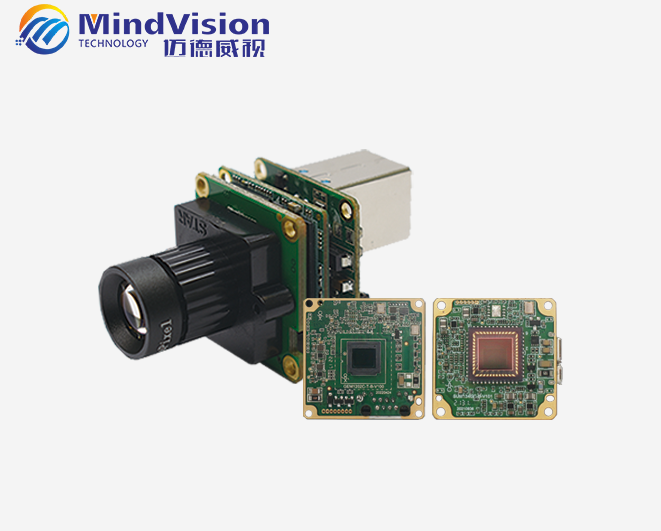
In this transition, stereo vision modules and ultra-thin board-level cameras have become two of the most essential hardware forms in embedded vision. Stereo modules give machines depth perception for SLAM navigation, obstacle avoidance, and 3D measurement. Board-level cameras provide highly integrated vision interfaces for space-constrained mobile devices through extreme miniaturization and low power consumption.
Six Core Scenarios of Embedded Vision
1. Robot Autonomous Navigation and SLAM
What is needed: Real-time depth perception, millisecond-level synchronization, and low power consumption. Mobile robots need to map and localize without GPS, making stereo vision a core sensor.
Why it is difficult: If the synchronization error between left and right images reaches millisecond level or above, depth calculation will produce "ghosting" and drift. At the same time, robots have extremely limited power budgets and installation space, making it hard for traditional industrial cameras to satisfy both.
Recommended solution: Stereo vision modules with microsecond-level hardware synchronization, supporting continuous, software-trigger, and hardware-trigger modes, with automatic left-right image synchronization. Baseline is customizable — 5–10 cm for short range (<2 m), 20–30 cm for long range (5–10 m).
MindVision recommendation: USB3.0/GigE stereo camera module series, supporting lossless RAW output (8/12/16-bit grayscale) to preserve complete image data for AI algorithms.
2. Robotic Arm Guidance and Precision Grasping
What is needed: Miniaturization, lightweight design, and high frame rate. The camera must be mounted at the end of a robotic arm, and any extra weight increases motion inertia and vibration.
Why it is difficult: Traditional industrial cameras often weigh hundreds of grams, significantly reducing trajectory accuracy and efficiency when mounted on a robotic arm. In confined workstations, standard cameras cannot be deployed at all.
Recommended solution: Split-type miniature cameras with a sensor head weighing ≤20 g, embeddable in extreme positions where traditional cameras cannot be installed.
MindVision recommendation: Coaxial split camera MV-MS136GC/GM. The sensor head measures 14 mm × 14 mm × 48 mm, delivers 120 fps at 1.3 MP, and uses a global shutter to eliminate smear. A single coaxial cable handles image transmission, trigger control, strobe synchronization, and power, with total power consumption of about 1 W.
3. Multi-Camera Synchronized Perception Network
What is needed: Synchronized access for multiple cameras, a unified time base, and centralized processing.
Why it is difficult: In multi-camera systems, frame synchronization and timestamp alignment are prerequisites for correct data fusion. Traditional solutions require separate trigger and power cables for each camera, resulting in complex wiring and many failure points.
Recommended solution: Native matched frame grabber solutions supporting 4/8/12 synchronized camera inputs, maintaining 70 fps across all channels. GMSL solutions can achieve synchronization accuracy below 1 ms through PTP timestamps.
MindVision recommendation: Coaxial split cameras + native multi-channel frame grabbers. The frame grabber has a built-in efficient transmission protocol to reduce CPU load, and supports independent parameter adjustment or batch configuration for each camera.
4. Edge AI Real-Time Inference
What is needed: Inference completed on the camera or at an edge device adjacent to the camera, uploading only structured results to reduce bandwidth usage and closed-loop latency.
Why it is difficult: In traditional solutions, RAW images are transmitted to an industrial PC or server before algorithms run, resulting in high latency, high bandwidth consumption, and failure when the network goes down.
Recommended solution: AI inference is moving from servers and industrial PCs down to sensors, camera processors, AI MCUs, and vision SoCs. Available chip platforms range from 1–2 TOPS TI AM62A to 100 TOPS Qualcomm IQ-9075.
MindVision recommendation: X86 smart camera series with built-in AI inference, performing OCR, code reading, and defect classification directly on the camera. It supports edge deployment without a separate IPC.
5. Precision Inspection in Confined Spaces
What is needed: Extreme miniaturization, high resolution, and flexible deployment.
Why it is difficult: Precision manufacturing and semiconductors demand increasingly high microscopic inspection accuracy. However, due to the internal structure of the inspected object and the external installation environment, imaging equipment often cannot be deployed in place.
Recommended solution: Split-type design — the sensor head is deployed at the confined inspection position, while the processing unit is placed in a standard chassis outside the equipment cavity, connected by a single cable for "flexible deployment + centralized processing."
MindVision recommendation: Coaxial split camera MV-MS136GC/GM. Its module cross-section is only 11.5 × 11.5 mm and can pass through an approximately 16 mm mounting hole. In LED placement, its miniature size significantly increases workstation density, enabling more parallel processing stations and reducing overall cycle time.
6. Embedding into Space-Constrained Mobile Devices
What is needed: Board-level form factor, low power consumption, and cross-platform compatibility.
Why it is difficult: Mobile devices and compact terminals have extremely limited motherboard space, and standard industrial cameras with C/CS mounts and housings simply cannot be embedded.
Recommended solution: Board-level cameras/modules that embed directly into the device motherboard in a single-board form factor, supporting PC Linux and ARM Linux.
MindVision recommendation: GigE/USB3.0 board-level camera modules supporting 16-bit grayscale and 48-bit color lossless output, with options for board-only, C-mount, and M12 interfaces. They are Vision-compliant and seamlessly compatible with Halcon, VisionPro, Labview, and other vision software.
Embedded Vision Camera Selection Comparison Table
| Scenario | Camera Form | Interface | Key Metrics | Special Requirements |
|---|---|---|---|---|
| Robot SLAM | Stereo module | USB3.0 / GigE | Microsecond sync, adjustable baseline | Lossless RAW output |
| Robotic arm guidance | Split miniature | Single coaxial cable | ≤20 g, 120 fps | Global shutter, 3 Gb/s bandwidth |
| Multi-camera network | Split + frame grabber | Coaxial / GMSL | 4/8/12-channel sync, 70 fps | Native frame grabber |
| Edge AI inference | Smart camera | GigE / X86 | Onboard AI inference | Low latency, works offline |
| Confined-space inspection | Split miniature | Single coaxial cable | 11.5 mm module cross-section | Fits through 16 mm mounting hole |
| Mobile device embedding | Board-level module | GigE / USB3.0 | Single-board form factor | 16-bit/48-bit lossless output |
Deep Dive into Key Specifications
Interface Selection: More Than Just Bandwidth
The core trade-offs in embedded vision interface selection are distance, bandwidth, and wiring complexity.
MIPI CSI-2 suits extremely compact scenarios where the camera is within 30 cm of the processor, offering 10 Gbps total bandwidth over 4 lanes and power consumption below 1 W. GMSL extends transmission distance to 15 m through serializer/deserializer solutions and supports PoC single-cable power, but configuration is complex, requiring separate integration for each camera and sensor. The single coaxial cable solution achieves 15 m transmission, 1 W power consumption, and four functions in one — image, trigger, strobe, and power — at 3 Gb/s, making it a pragmatic choice that balances performance and engineering complexity in embedded scenarios.
Synchronization Accuracy: The Lifeline of Stereo and Multi-Camera Systems
The depth calculation accuracy of stereo vision directly depends on the synchronization error between left and right images. Microsecond-level hardware synchronization is the baseline — if the error reaches millisecond level, depth calculation errors occur in fast-motion scenarios. In multi-camera systems, GMSL solutions can achieve synchronization accuracy below 1 ms through PTP timestamps, but software must still ensure that each camera's capture thread operates on the same time base.
Power and Thermal Management: Hard Constraints of Embedded Systems
Embedded devices usually have no active cooling, so camera power consumption directly affects stable operation. MIPI modules typically consume less than 1 W, and the single coaxial cable solution consumes about 1 W overall, making them suitable for power-sensitive mobile devices. Board-level cameras eliminate housings and interface connectors, further reducing power consumption, making them the preferred form for battery-powered devices.
Five Common Pitfalls in Embedded Vision Integration
Pitfall 1: Incorrect device tree configuration. Device tree descriptions for MIPI CSI-2 and GMSL cameras must strictly match the hardware design. Any error in I2C address, clock frequency, or channel mapping can prevent the camera from being recognized.
Pitfall 2: Incorrect serializer/deserializer initialization order. In GMSL systems, serializer and deserializer initialization follows strict timing requirements. On Jetson platforms, this is usually done at boot via media-ctl scripts. Failure at any step can prevent subsequent channels from outputting images.
Pitfall 3: Multi-camera synchronization without hardware trigger. Software triggers introduce jitter, causing data fusion errors in multi-camera SLAM and 3D reconstruction. Hardware triggers and PTP time synchronization should be prioritized.
Pitfall 4: Insufficient bandwidth planning. For 1080P@60fps RAW10, a single frame is about 2.6 MB, or 156 MB per second. In multi-camera scenarios, bandwidth and CPU load must be planned in advance.
Pitfall 5: Ignoring SDK cross-platform capability. In embedded development, algorithms are often validated on an X86 development machine and then migrated to an ARM platform. If the SDK is not cross-platform, low-level capture code must be rewritten, greatly extending development time.
FQA: Frequently Asked Questions About Embedded Vision Integration
It depends on whether depth information is needed. SLAM navigation, obstacle avoidance, 3D measurement, and volume estimation require stereo or multi-camera solutions to obtain depth maps. Pure appearance inspection, code reading, OCR, and other 2D tasks can use monocular cameras. MindVision stereo modules support microsecond-level hardware synchronization and customizable baseline (5–30 cm), while monocular solutions have advantages in cost and power consumption.
The key lies in the vendor's cross-platform SDK design. MindVision's dedicated SDK supports Windows, Linux, ARM Linux, and macOS, and is fully compatible with its single-camera product SDK. This means developers can validate algorithms on an X86 development machine and then migrate directly to an ARM embedded platform through the same SDK interface, without rewriting low-level capture code.
Traditional industrial cameras use an integrated design, with sensor, processing circuit, and interface in the same housing, making it impossible to reduce size and weight. Coaxial split cameras separate the sensor head from the processing unit. The sensor head measures only 14 mm × 14 mm × 48 mm and weighs ≤20 g, connecting to the processing unit via a single coaxial cable. This solves two fundamental problems: traditional cameras "cannot fit" into confined spaces and are "too heavy," affecting robotic arm accuracy.
For power-sensitive scenarios, prioritize board-level cameras or single coaxial cable solutions. MindVision coaxial split cameras consume about 1 W overall, with a single cable handling both power and data transmission, eliminating separate power wiring at the camera end. Board-level modules further reduce power consumption by eliminating housings and connectors.
At the hardware level, MindVision coaxial split cameras come with native 4/8/12-channel frame grabbers, supporting up to 12 synchronized camera inputs and maintaining 70 fps across all channels, with independent or batch parameter configuration for each camera. At the software level, the SDK provides synchronization trigger interfaces to coordinate all cameras' capture actions on the same time base.
Both approaches have their use cases. Camera-side inference (such as MindVision X86 smart cameras) suits scenarios requiring extremely low latency and simplified system architecture, performing OCR, code reading, and classification directly on the camera and uploading only structured results. Edge-device-side inference (such as Jetson platforms) suits scenarios requiring multiple high-resolution AI models and greater compute. The choice depends on latency budget, compute requirements, and system complexity.
It mainly depends on three factors: the cross-platform maturity of the camera SDK, the degree of pre-integration of the target platform BSP, and the standardization of the capture pipeline. Choosing a camera model with proven cases on the target platform can compress driver porting and validation from weeks to days. MindVision provides embedded processing system customization services for ARM platforms ranging from HiSilicon, Allwinner, and Forlinx to Raspberry Pi and NVIDIA, with SDK coverage across multiple platforms.
Quick Reference: Matching MindVision Products to Embedded Scenarios
| Scenario | MindVision Product Series | Key Specification Highlights | Recommended Accessories |
|---|---|---|---|
| Robot SLAM | Stereo camera module (USB3.0/GigE) | Microsecond sync, 5–30 cm customizable baseline | None (module integrated) |
| Robotic arm guidance | Coaxial split MV-MS136GC/GM | ≤20 g, 120 fps, 3 Gb/s | Native frame grabber |
| Multi-camera network | Coaxial split + 4/8/12-channel frame grabber | 12-channel sync, 70 fps all channels | Coaxial cable |
| Edge AI inference | X86 smart camera | Onboard AI inference, works offline | Ring light + FA lens |
| Confined-space inspection | Coaxial split MV-MS136GC/GM | 11.5 mm module cross-section | Coaxial cable |
| Mobile device embedding | GigE/USB3.0 board-level module | 16-bit/48-bit lossless | Board-only/C-mount/M12 |
Final Thoughts
Embedded vision is redefining the role of industrial cameras. As AI inference moves from servers down to cameras and edge devices, the camera is no longer just an image capture component, but the starting point of the perception-decision loop in intelligent devices.
For embedded vision developers, the most effective strategy is not to pursue the camera with the highest specifications, but to choose the solution with the best match to the target platform, the most mature SDK ecosystem, and the form factor best suited to the scenario. Stereo modules solve depth perception, board-level cameras solve space constraints, split designs solve deployment flexibility, and smart cameras solve inference latency — each form factor addresses a different embedded pain point.
In these "soft" capabilities — cross-platform SDKs, native frame grabber support, microsecond-level synchronization, and single-cable power — MindVision's product portfolio is providing a complete "perception foundation" for embedded vision, allowing developers to focus on algorithms and applications rather than repeated trial and error in driver adaptation and hardware matching.
About MindVision
MindVision Technology Co., Ltd. was founded in 2013 and is headquartered in Shenzhen, with production centers and R&D bases in Changsha and Wuxi, employing nearly 300 people. Its product portfolio covers area-scan cameras, line-scan cameras, thermal imaging cameras, smart cameras, 3D cameras, stereo camera modules, board-level camera modules, and custom camera systems, with over 100 patents and software copyrights. In embedded vision, its stereo modules and board-level cameras have been widely used in scientific research, intelligent transportation, biomedical, non-standard automation, electronics manufacturing, photovoltaic inspection, semiconductors, and public security.
For more information or free selection consulting, please visit MindVision's official website or contact its sales team.
#MindVision
MindVision Technology Co., Ltd. is a professional domestic industrial camera manufacturer headquartered in Shenzhen, with production centers and R&D bases in Changsha (Hunan) and Wuxi (Jiangsu), employing nearly 300 people. Its product portfolio covers area-scan cameras, line-scan cameras, thermal imaging cameras, smart cameras, 3D cameras, stereo camera modules, board-level cameras, and custom camera systems, with over 100 patents and software copyrights. The company is ISO9001 certified.
For more information or free selection consulting, please visit MindVision's official website or contact the sales team.
We’ll be glad to help you
Please Login
Full Name
Company Name
E-mail*
Country / Region
Your Needs / Application*
Verification code

Get in touch
Name*
E-mail*
Country*
Your Needs / Application*
