
Inside the MindVision MV-PX41000C/M — China's First 410-Megapixel Industrial Camera
Key Takeaways
- The MV-PX41000C/M is China's first 410-megapixel industrial camera, built on Canon's LI8030 full-frame CMOS sensor with 24,592 × 16,704 effective pixels (24K-class resolution).
- Quad-channel CoaXPress-12 (CXP-12) delivers 48 Gbps of aggregate bandwidth — enough to stream full-resolution 14-bit images at 8 fps, uncompressed, with zero dropped frames.
- A single frame can cover an entire 12-inch wafer or a large display panel, replacing the dozens of stitched partial captures a conventional 5MP camera would need.
TEC thermoelectric cooling plus water cooling keeps sensor noise and dark current stable through 24/7 production duty cycles.
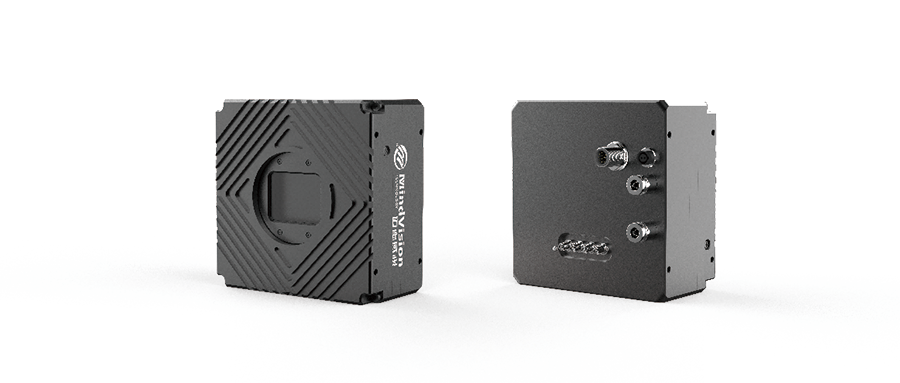
Canon Asked the Question. MindVision Built the Answer.
When Canon unveiled its 410-megapixel LI8030 CMOS image sensor — the most pixels ever packed onto a 35mm full-frame format — the machine vision industry immediately asked a practical question: what could this sensor actually do inside an industrial camera?
Canon posed that question publicly on its official social channels. The MV-PX41000C/M is MindVision's answer: China's first 410-megapixel industrial camera. Canon engineered the sensor; MindVision engineered everything around it — the 48 Gbps CoaXPress-12 data path, the dual-channel cooling, the electronics, and the industrial-grade housing — to turn a record-setting sensor into a camera that runs reliably on production lines, around the clock.
What Does 410 Megapixels Actually Mean?
The MV-PX41000C/M resolves 24,592 × 16,704 pixels — roughly 410 megapixels, or 24K-class resolution:
| Resolution baseline | Equivalent to… |
|---|---|
| 1080p Full HD | 198 frames |
| 4K Ultra HD | 49 frames |
| 8K | 12 frames |
But the raw pixel count is only half the story. All 410 million pixels sit on a 35mm full-frame, back-illuminated (BSI) stacked CMOS sensor with a 1.5 μm pixel pitch, and that combination is what makes the camera practical rather than just impressive:
- It works with standard full-frame industrial lenses. No medium-format optics, no exotic custom glass, no premium lens budget.
- You can crop freely. Zoom into any region of the image and there is still enough resolution for measurement-grade analysis — one capture serves both documentation and inspection.
- Large field of view and micron-level precision coexist in the same frame — two things machine vision engineers normally have to trade off.
One Frame, One 12-Inch Wafer
Anyone who builds inspection systems for semiconductors or flat panel displays knows the resolution-versus-coverage trade-off. High resolution means a small field of view, so large targets require many partial captures followed by image stitching. Every stitch costs cycle time, every seam risks a missed defect, and every mechanical movement adds positioning error.
Concretely: a 5-megapixel camera needs roughly 80 partial captures to cover a 12-inch wafer, and stitching alone can consume more than 40% of total inspection time.
With matched optics, the MV-PX41000C/M covers the entire wafer — or a complete large-size display panel — in a single frame, at inspection granularity down to 1 μm per pixel. Inspection cycles shrink from minutes to tens of seconds, with no seams to miss defects in.
6 GB/s: Why the Interface Matters as Much as the Sensor
Ultra-high-resolution imaging creates a data problem before it creates value. Do the math on the MV-PX41000C/M:
That immediately rules out the interfaces most industrial cameras rely on. GigE tops out at 1 Gbps, USB3 at 5 Gbps, 10GigE at 10 Gbps — an order of magnitude short of what a 410-megapixel camera needs. This is why the interface decision, not the sensor, determines whether an ultra-high-resolution camera is actually usable on a production line.
Why CoaXPress-12 Is the Right Interface for High-Resolution Machine Vision
The MV-PX41000C/M carries a quad-channel CXP-12 interface fully compliant with the CoaXPress 2.1 standard, with 48 Gbps of aggregate bandwidth — enough headroom to output full-resolution 14-bit images at 8 fps with no compression and no frame loss. CoaXPress-12 is also the standard interface across MindVision's entire PX series of high-speed machine vision cameras.
| Interface | Bandwidth | Cable / distance | Single-cable power |
|---|---|---|---|
| GigE | 1 Gbps | Ethernet / 100 m | PoE |
| USB3 | 5 Gbps | USB / 3–5 m | Bus-powered |
| CameraLink Full | ≈6.8 Gbps | Proprietary / ≈10 m | No |
| 10GigE | 10 Gbps | Ethernet / 50–100 m | PoE++ |
| CXP-12 × 4 | 48 Gbps | Coaxial / 10–65 m | PoCXP |
Six reasons CoaXPress-12 wins for industrial cameras
- Bandwidth headroom. 12.5 Gbps per link, 48 Gbps across four links — about five times 10GigE, and currently the only mainstream industrial camera interface that can carry a 410MP, 8 fps uncompressed stream.
- Power, control and data over one coaxial cable (PoCXP). Radically simpler cabling on large inspection systems.
- EMI immunity. Shielded coaxial cable stays stable in factory environments dense with motors, servos and variable-frequency drives.
- Long-distance transmission. 10–65 m cable runs reach across large production lines and into remotely mounted cabinets.
- Deterministic latency. Low, predictable link delay with hardware triggering and multi-camera synchronization for line-rate inspection.
- Standards ecosystem. CoaXPress 2.1 and GenICam compliance means plug-and-play compatibility with mainstream CXP frame grabbers and vision software.
Built for the Factory Floor, Not the Lab Bench
A sensor this dense generates heat, and heat degrades image quality. Two design decisions keep the MV-PX41000C/M stable through 24/7 operation:
- TEC thermoelectric cooling plus water cooling in an aluminum body actively manage sensor temperature, holding noise and dark current steady over long duty cycles;
- A CNC-machined all-metal housing (120 × 120 × 50 mm, under 600 g, IP40) provides electromagnetic compatibility and mechanical robustness.
Image processing also happens where it should — inside the camera. An on-board FPGA ISP engine with a large frame buffer handles arbitrary ROI, white balance, gamma, black-level calibration, 3D noise reduction, custom bad-pixel correction and user LUTs, so the host PC's CPU is left free for the actual inspection software. Comprehensive I/O (two RS422 differential inputs, one opto-isolated input, three non-isolated OC outputs) and dual power options (DC24V or PoCXP) round out the integration story.
Where a 410-Megapixel Industrial Camera Wins
- Semiconductor wafer and advanced packaging inspection. One frame per 12-inch wafer — no stitching, no seam defects, flip-chip and BGA alignment captured in a single pass.
- Flat panel display inspection (OLED, Mini-LED, Micro-LED). Whole-panel imaging that catches bright points, dark lines and Mura non-uniformity across large screens in one shot.
- Photovoltaic cell grid-line inspection. 1.5 μm pixels resolve busbar and finger-line printing defects that determine cell efficiency.
- Aerial surveying and 3D reconstruction. 8 fps uncompressed output supports high-overlap, motion-blur-free capture for photogrammetry.
- PCB inspection, biomedical imaging and aerospace research — any application where large field of view and high precision must coexist.
MV-PX41000C/M: Specifications at a Glance
| Parameter | Specification |
|---|---|
| Sensor | Canon LI8030 CMOS (color / monochrome) |
| Effective pixels | 24,592 × 16,704 (approx. 410 megapixels) |
| Optical format / pixel size | 2.7″ (35mm full frame) / 1.5 μm × 1.5 μm |
| Resolution @ frame rate | 24,576 × 16,704 @ 8 fps (14-bit) |
| Data interface | CoaXPress 2.1 · 4-channel CXP-12 (48 Gbps) · PoCXP |
| Sensitivity (monochrome) | 12,300 e/lx·s; quantum efficiency 62.4% @ 544 nm |
| Exposure time | 21.92 μs – 10 s |
| Lens mount | M58 × 0.75 |
| Cooling | TEC + water-cooled aluminum housing |
| Dimensions / weight | 120 × 120 × 50 mm / <600 g / IP40 |
| Supported systems | Windows / Linux / ARM |
* Full parameters are available in the MV-PX41000C/M technical white paper — request it using the contact details below.
Color or Monochrome?
Choose monochrome (MV-PX41000M) when sensitivity matters most: at 12,300 e/lx·s with 62.4% quantum efficiency, it is the stronger choice for low-light defect detection on wafers, panels and other high-contrast inspection tasks.
Choose color (MV-PX41000C) when the application depends on color information — color filter inspection, cosmetic sorting, or any task where a defect is defined by hue rather than luminance.
Frequently Asked Questions
What is the MV-PX41000C/M?
Why do high-resolution industrial cameras need CoaXPress-12 instead of GigE or USB3?
How much image data does a 410MP industrial camera generate?
What lens and accessories does the MV-PX41000C/M require?
What industries use ultra-high-resolution industrial cameras?
Get the Technical White Paper or Arrange a Demo
- 📧 Sales inquiries: globalmarket@mindvision.com.cn
🌐 Web: www.mindvision.ltd
From Canon's record-setting 410-megapixel sensor to an industrial camera that runs dependably on the production line — combining a large field of view with high precision is becoming the new benchmark for high-end manufacturing inspection.
— MindVision · Professional industrial camera manufacturer —

